
25 October 2026
The Meitheal of God's Love
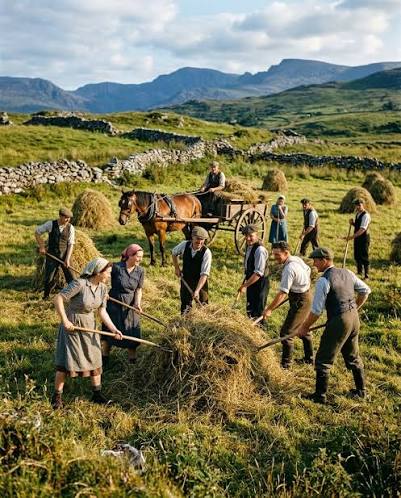
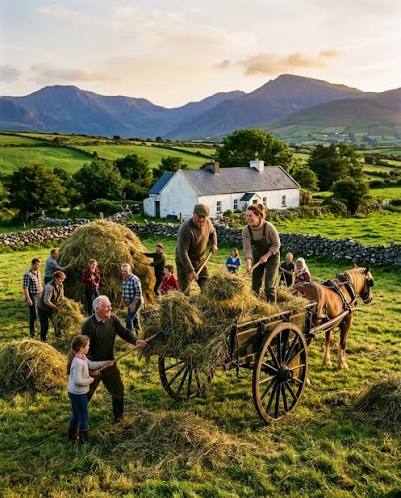
Think about the last time you felt truly overwhelmed. Maybe it was a mountain of emails, a chaotic household, or just the heavy weight of a world that feels like it is fraying at the edges. In those moments, when we turn to the Gospel and hear Jesus tell us to love God with our entire heart, soul, mind, and strength—and then to love our neighbor as ourselves—it can feel less like an invitation and more like another item on an already impossible to-do list. We wonder: How is that even possible? How do I find the strength to love perfectly when I can barely find the time to breathe? The secret is that these two commands aren't two separate chores. They are actually one single movement of the heart. To understand this, we can look back to a beautiful tradition from rural Ireland in the 1950s and 60s called the meitheal. A meitheal was a coming-together of neighbors for a common purpose. When the summer sun hit the meadows and the hay needed to be saved before the rain arrived, or when the turf needed to be gathered from the bogs, one farmer couldn't do it alone. So, the neighbors would arrive. They didn't wait to be asked, and they didn't do it for a paycheck. They worked the fields of one neighbor, then moved to the next, and the next, until every family's winter stores were secure. The meitheal was not just a labor strategy; it was love in action. It was the lived realization that my survival is tied to yours, and your well-being is my own. In those meadows, the "strength" Jesus speaks of in the Gospel wasn't an abstract spiritual concept—it was the physical strength of a neighbor's arm helping to lift a heavy load. It was the patience of working through the heat of the day for someone else's benefit. In the meitheal, you didn't have to feel a deep, mystical emotion to be loving; you just had to show up and do the work. This is exactly what Jesus is teaching us today. We often treat love as a feeling we have to conjure up, but the Bible describes love as a choice we make. In the reading from Exodus, God doesn't give the people a vague suggestion to be "nice." He gives them a concrete mandate: protect the stranger, care for the widow, and look after the orphan. He is telling us that if we want to find Him, we don't need to climb a mountain or hide in a cave. We just need to find our own "meadow"—the place where someone else is struggling and needs a hand. In our modern world, we have lost many of these communal rhythms. We live behind fences and screens, and we often feel we must carry our burdens in isolation. But the call of the Gospel is to recreate the spirit of the meitheal in our own lives. When we see a lonely neighbor, a struggling coworker, or a family in crisis, we are not being interrupted. We are being invited to enter into a sacred partnership. The "strength" Jesus asks us to use in loving God is the same strength we use to be patient with a difficult relative, to forgive a mistake, or to spend an hour listening to someone who has no one else to talk to. When we step out of our own needs to serve someone else, we find that the distance between us and God has already disappeared. As we leave here today, I invite you to stop looking for a "perfect" kind of love and instead look for a "present" kind of love. Ask yourself: Who is in my life right now whose "hay" is falling, whose "turf" is too heavy to gather alone? Love is not a feeling we fall into; it is a path we walk together. When we show up for one another, we discover that in loving our neighbor, we have already begun to love God with everything we have.